Giethoorn, Netherlands: A Guide to the Village Without Roads
Canals, thatched cottages and no cars at all — boat prices, journey times and how to see it without the crowds.
GeoParallaxFilmed & written on locationGiethoorn: Fairytale Village, Travel Tips & Beyond
Giethoorn, the Dutch village without roads — its canals, wooden bridges and thatched farmhouses, the whisper boats, the museums, and the Overijssel towns worth adding to the trip. Filmed on location in the Netherlands.
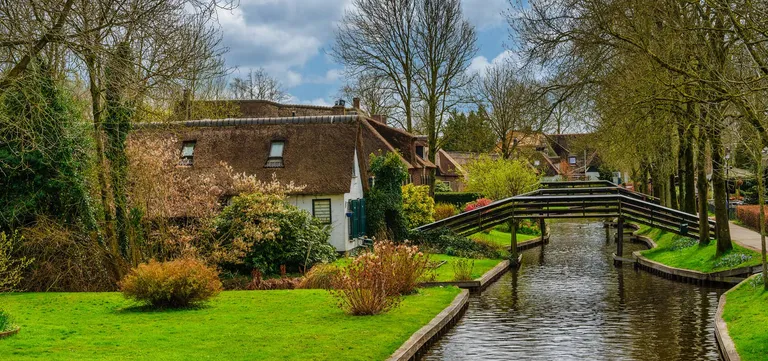
Giethoorn is the Dutch village where canals replace streets: thatched farmhouses on private islands, wooden bridges by the dozen, and boats where cars would be. After filming the village for GeoParallax, we’ve gathered the best things to do in Giethoorn — whisper boats, the Binnenpad on foot, the museums — with verified prices, journey times from Amsterdam, and the quiet hours the day-trippers miss.
You reach it in about an hour and a half from Amsterdam, park on the edge, and continue by boat or on foot. Below: how to get here, what it costs, how long to stay, when to come — then the village itself, and the Overijssel towns worth adding to the drive.
Table of Contents
- How do you get to Giethoorn from Amsterdam? (Journey times & fares)
- What does Giethoorn cost? (Boats, museums & parking, verified)
- How long do you need in Giethoorn?
- When is the best time to visit Giethoorn?
- Can you drive into Giethoorn? (Parking & the P-Route)
- A village born from water: the history of Giethoorn
- 1. By boat: the essential Giethoorn experience
- 2. On foot: the Binnenpad and the bridges
- 3. By bicycle: into the national park
- 4. Museums, history and nature
- 5. Eating in Giethoorn: canal-side tables and Dutch treats
- 6. Unusual things to do in Giethoorn
- Visiting responsibly: 2,800 residents, a million visitors
- Beyond the village: the Overijssel towns worth adding
- Frequently Asked Questions
- Useful Links & Resources
- Our Photography Portfolio
How do you get to Giethoorn from Amsterdam? (Journey times & fares)
Giethoorn sits in the northeast of the Netherlands, inside the Weerribben-Wieden National Park — the largest fenland in northwestern Europe. It feels remote and isn’t, which is why a day trip from Amsterdam works: the city is about 120 km away, roughly ninety minutes by car. There is no train station in the village, so public transport means a train to Steenwijk and then a short bus ride.
| From | Distance | By car | By public transport |
|---|---|---|---|
| Amsterdam | ±120 km | ±1 h 30 | Train to Steenwijk (via Zwolle) + bus 70 · 2–2½ h · ±€58 return |
| Schiphol Airport | ±135 km | ±1 h 35 | Train + bus 70 · ±2½ h |
| Utrecht | ±115 km | ±1 h 20 | Train to Steenwijk + bus 70 · ±2 h |
| Rotterdam | ±176 km | ±1 h 45 | Train + bus 70 · ±3 h |
| Zwolle | ±40 km | ±0 h 30 | Train to Steenwijk + bus 70 · ±1 h |
| Steenwijk (nearest station) | ±8 km | ±0 h 12 | Bus 70 to Dominee Hylkemaweg · ±15 min |
| Kampen | ±45 km | ±0 h 35 | — |
| Keukenhof (in tulip season) | ±150 km | ±1 h 45 | — |
Approximate, without stops. Driving is mostly motorway at 100 km/h, with the last fifteen minutes on smaller N and B roads. Follow the colour-coded P-Route signs rather than a house number; the two large public lots sit at Bartus Warnersweg (‘P-centrum dorp’), at the edge of the car-free zone.
By car gives you the freedom the film was built around — the countryside between the motorway and the village is itself worth the drive, and the towns further out (below) only work with your own transport. By train and bus costs around €58 return and takes 2 to 2½ hours each way; check NS and 9292.nl for live times. Organised day tours from Amsterdam start at roughly €65–79 per person, usually including a canal cruise and sometimes a second stop such as the Zaanse Schans windmills; small-group tours run higher.

What does Giethoorn cost? (Boats, museums & parking, verified)
Giethoorn itself is free to enter — there is no gate, no ticket, no charge for walking the paths or crossing the bridges. What costs money is the water and the museums, and neither is expensive: an electric whisper boat runs from about €20 an hour, a guided cruise about €10–15 a head, and the village museum €7.50. The current rates:
| What | Price | Notes |
|---|---|---|
| Electric whisper boat | from ±€20 per hour · ±€100 per day | Up to 6 people; no licence needed; online is cheaper than the jetty |
| Larger boat / sloop | from ±€35 per hour | Book ahead in season |
| Guided canal cruise | ±€10–15 per person (indicative) | ±1 hour, covered boats, live commentary |
| Canoe or kayak hire | €15–20 per day | Quieter still, and closer to the water |
| Bicycle hire | ±€10–15 per day | E-bikes and children’s bikes available |
| Museum Giethoorn ‘t Olde Maat Uus | €7.50 adult · €2.50 child (4–12) | Free under 4 and with a Museumkaart. 1 Apr–31 Oct daily 11:00–17:00; 1 Nov–31 Mar Friday–Monday 11:00–16:00 (daily in Dutch school holidays; closed 25–26 Dec, 31 Dec, 1 Jan) |
| Museum De Oude Aarde | Admission at the door | Gems, minerals and fossils; up a steep bridge. 1 Oct–31 Mar Wed–Sun 10:00–17:00, daily during Dutch school holidays |
| Shell gallery Gloria Maris | Free | Rare shells, including two Gloria Maris |
| Parking (P-Route) | Free almost everywhere | A secured lot ±€6/day; fine outside the zones ±€95 |
Museum Giethoorn ‘t Olde Maat Uus prices and hours are the museum’s published 2026 rates, valid to 31 December 2026; De Oude Aarde’s opening hours and the Giethoorn parking rules are the operators’ and the official tourism site’s published information, all checked on 24 August 2026. Boat, canoe, cruise and bicycle rates vary by operator and by season and most operators publish no rate card — those figures are indicative only. Train fares are quoted by NS at the time of booking. Confirm everything when you book.
Booking a boat online is consistently cheaper than hiring at the jetty.
How long do you need in Giethoorn?
Half a day is the honest minimum and covers the essentials: an hour or two steering a whisper boat through the village canals, a walk along the Binnenpad, and lunch at a canal-side table. A full day adds a museum, a bike ride into the Weerribben-Wieden, or a longer boat route out onto the Bovenwijde lake.
Out there the village drops away and the reed beds take over. But the recommendation we’d actually make is to stay a night. The coaches from Amsterdam arrive late morning and leave by mid-afternoon; what’s left afterwards — still water, low light, someone rowing home with the shopping — is the village everyone came to see and most people miss by three hours.
When is the best time to visit Giethoorn?
Giethoorn is open all year, so the question is really about crowds — and the hours matter more than the month. Arrive before 10:00 or after 16:00, and choose a weekday over a weekend. That single decision changes the experience more than the season does. For seasons, spring (April–May) and autumn (September–October) are the sweet spots.
Spring brings blossom, gardens coming back and comfortable boating weather with a fraction of summer’s volume; autumn is warm-toned, quiet and still fully open. Summer (June–August) has the long evenings and every boat on the water, but also the peak of the day-trip traffic. Winter is a different village altogether — frost on the thatch, most boat hire closed, and in a properly cold year (increasingly rare) the chance of locals skating the frozen canals.
Can you drive into Giethoorn? (Parking & the P-Route)
No — and that is the whole point. When cars arrived, Giethoorn chose to keep them out of the historic centre, which is why the village still sounds like ducks and bicycles rather than engines. Visitors park on the edge and walk in. We left the car at the northern lots every time and never walked more than five minutes.
The system is well signposted and easy: follow the colour-coded P-Route signs — green for the centre, red for the south, yellow for the north — to the car parks around the village periphery — each lot signed by its colour and number. Parking is free almost everywhere. From almost any of them it’s a four- or five-minute walk to the canals, boat rentals and restaurants; the large ‘Green P1’ area beside the Plus supermarket in the centre is the handiest if you want to pick up picnic supplies first. A secured lot charges around €6 for the day. Parking outside the marked zones risks a fine of roughly €95, so stick to the signs. Many hotels, restaurants and boat-rental companies also offer free parking to their own guests — worth asking when you book.
A village born from water: the history of Giethoorn
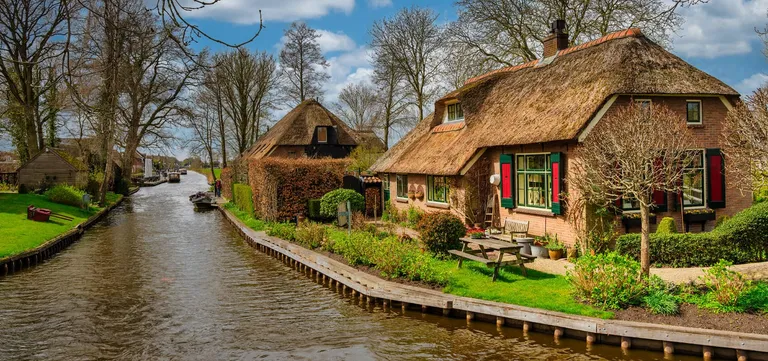
Giethoorn exists because of peat. From around the 13th and 14th centuries, settlers — fugitives first, later monks — dug through the marshland here to extract peat, the fuel that heated the Low Countries. They stacked it to dry on narrow strips of land called legakkers, and the trenches they emptied filled with water.
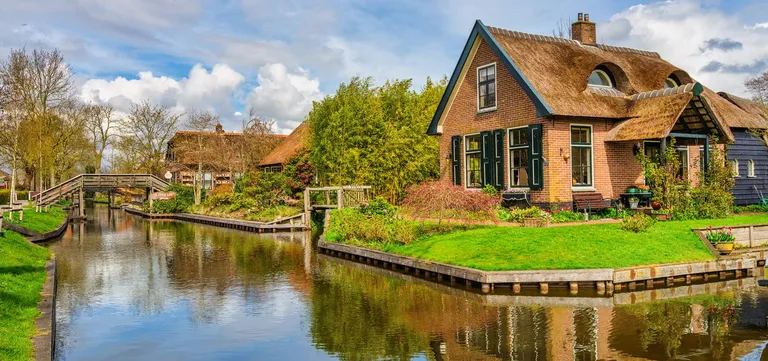
Floods in 1776 and 1825 merged those diggings into the lakes and canal network that exist today, leaving the higher strips as small islands. The farmhouses were built on the islands; the bridges came because there was no other way across.
Even the name comes out of that landscape. Early inhabitants are said to have found hundreds of goat horns — gietehorens — in the marsh, most likely deposited by a great flood in the 10th or 12th century. The village took its name from the bones in the mud.
1. By boat: the essential Giethoorn experience
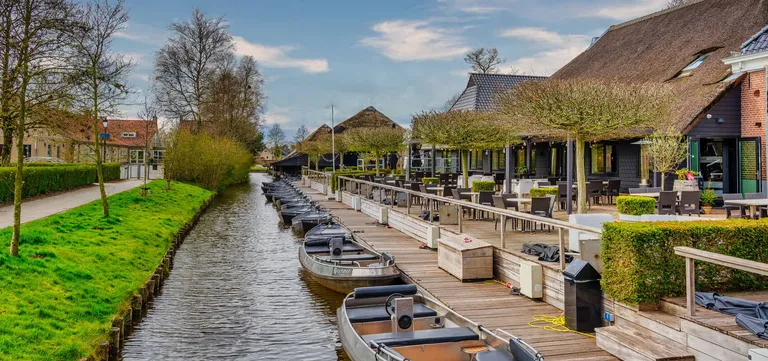
Boats are not a tourist activity in Giethoorn, they’re the infrastructure: the canals are the streets, and the perspective from the water is the one the village was designed around. Reckon on 1½ hours for the village loop, or 2 hours plus if you want to add the Bovenwijde lake.
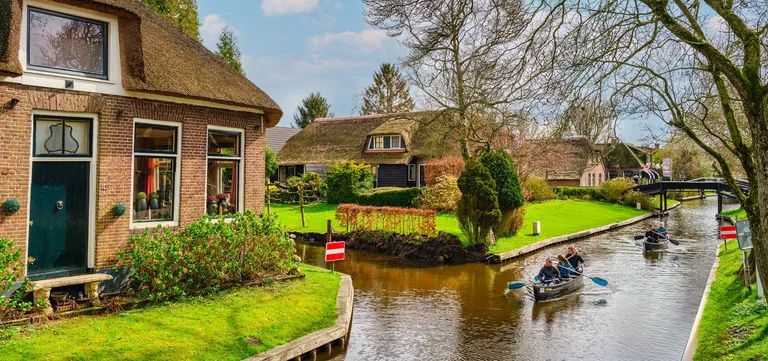
- Whisper boats (fluisterboot) — the standard choice. Small open boats with quiet electric motors, easy to steer, no licence needed, from about €20 an hour booked online. You go at walking pace and the village slides past.
- Sloops — larger and more comfortable for groups, from around €35 an hour.
- Punters — the traditional flat-bottomed wooden boats that once carried peat and cattle; most now have electric motors too.
- Guided cruises — about an hour in a larger covered boat with a local skipper and commentary, €10–15 per person. Weatherproof, wheelchair-accessible options exist, and you learn more than you would alone.
- Canoe or SUP — for the quietest possible passage, and the best chance of birds.
Book online in advance for weekends, holidays and the April-to-September season: it’s cheaper than the jetty price and it guarantees a boat. Rental companies supply route maps; the classic circuit is the village loop, and the longer routes run out into the Weerribben-Wieden.
2. On foot: the Binnenpad and the bridges
Walking gives you what the boat can’t: the gardens, the doorways, the detail. The Binnenpad is the main footpath along the central canal and the village’s spine — a slow kilometre of thatched farmhouses, immaculate planting, and one wooden bridge after another. Langesteeg and Zuiderpad are quieter alternatives when the main path fills.
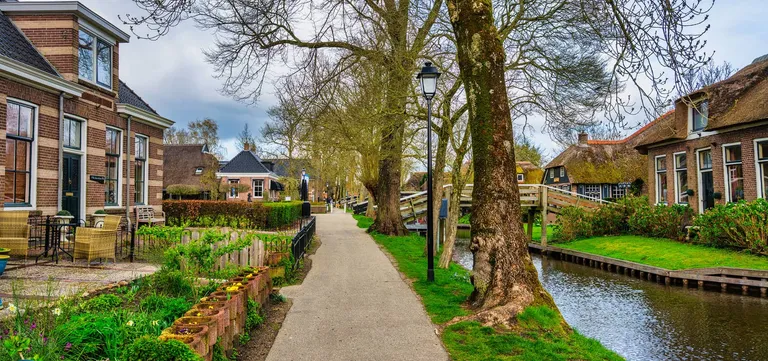
Along the way, look for the statue of Albert Mol near Café Fanfare. Mol (1917–2004) was a Dutch actor who appeared in Bert Haanstra’s comedy Fanfare, filmed in Giethoorn in 1958 — the film that made the village famous across the Netherlands. Sculptor Wim Kuijl’s statue was unveiled on the Binnenpad in October 2008 during the village’s Fanfare festival, and the café behind it was one of the film’s locations.
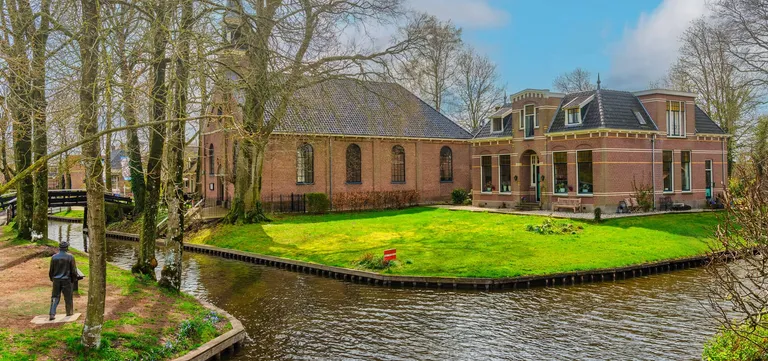
The paths are narrow and shared with cyclists, so keep your ears open. And remember the obvious thing that visitors forget: these are homes. Photograph freely from public paths and the water, but private bridges and gardens are exactly that.
3. By bicycle: into the national park
A bike gets you past the point where the footpaths end and into the landscape that surrounds the village — reed beds, lakes and marsh forest, all of it the long-term result of peat digging. Standard bikes, e-bikes and children’s bikes are available for around €10–15 a day.
The signposted 41.5 km ‘Giethoorn de Wieden’ route is the classic day loop, taking in the village and the wetlands beyond it; shorter marked routes exist if you’d rather do an hour. We rode part of it between filming days and had the reed beds to ourselves.
4. Museums, history and nature
Giethoorn’s museums cover the village’s whole story: Museum Giethoorn ‘t Olde Maat Uus recreates traditional life inside an authentic old farmhouse, De Oude Aarde shows gemstones, minerals and fossils gathered worldwide since 1969, and the Gloria Maris shell gallery is free to visit. All three sit in the village core, a short walk apart.
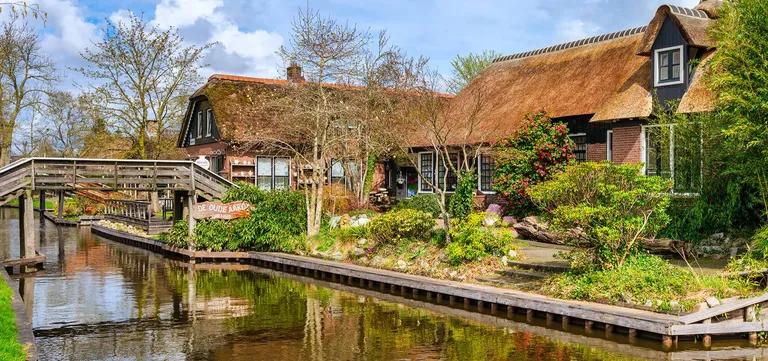
- Museum Giethoorn ‘t Olde Maat Uus — the village’s own story, told inside an authentic old farmhouse: peat digging, fishing, farming and daily life as it was a century ago, with volunteers on hand and audio guides in English, German and Chinese. €7.50 adult, €2.50 child (4–12), free with a Museumkaart. Open daily 11:00–17:00 from 1 April to 31 October; Friday to Monday, 11:00–16:00, from 1 November to 31 March.
- Museum De Oude Aarde (“The Old Earth”) — a private collection of gemstones, minerals and fossils gathered worldwide since 1969, including an enormous Brazilian amethyst geode. Open Wednesday to Sunday, 10:00–17:00, from 1 October to 31 March, and daily during Dutch school holidays. Note that it’s reached by a steep bridge and isn’t wheelchair-accessible.
- Shell gallery Gloria Maris — free to visit, and home to two of the roughly twenty-five known Gloria Maris shells in the world. Daily 10:00–18:00 from April to October.
- Weerribben-Wieden National Park — the fenland the village sits inside, and the reason the birdlife is so good. On a quiet boat you’ll see coots and moorhens at close range, oystercatchers working the shallows, lapwings over the fields, and mute swans that treat your boat as an obstacle rather than a threat.
5. Eating in Giethoorn: canal-side tables and Dutch treats
Most of the village’s restaurants line the water, and a terrace table with boats gliding past is a large part of the appeal. You’ll find the majority along the Binnenpad; fish features heavily, as it should in a place built on water. We ate canal-side twice and would again.
Three Dutch things to eat while you’re here: stroopwafels, two thin waffle layers glued with warm caramel syrup, best bought fresh rather than packaged; poffertjes, small puffed pancakes served hot with butter and icing sugar; and bitterballen, crisp-crumbed spheres of savoury beef ragout served with mustard, which exist to accompany a beer. Some kitchens also run hands-on Dutch cooking classes if you’d rather make them than order them.
6. Unusual things to do in Giethoorn
Beyond the boats and the Binnenpad, the village keeps a few quieter turns: the Schreur shipyard, where traditional wooden punts are still built by hand; archery ranges and mini-golf for families; guided walking tours on nature, history and culture routes; the craft, cheese and souvenir shops along the Binnenpad; and a bench on the bank for a picnic.
- Browse the shops along the Binnenpad for crafts, cheese and souvenirs.
- Visit the Schreur shipyard to see traditional wooden punts being built by hand.
- Try archery at one of the local ranges, or a round of mini-golf with the family.
- Take a guided walking tour — nature, history and culture routes all run.
- Find a bench or a stretch of bank and simply have a picnic; the village rewards sitting still better than most places reward moving.
Visiting responsibly: 2,800 residents, a million visitors
Around 2,800 people live in Giethoorn, and close to a million visitors come through each year. That ratio is the single most important thing to understand before arriving, and it costs nothing to get right. Visiting early or late helps the village as much as it helps you.
Keep your voice down near the houses (whisper boats are quiet, passengers often aren’t), stay on public paths and bridges, don’t step into gardens or onto private moorings, and don’t photograph through windows.
A note on accessibility: the narrow paths, stepped bridges and small boats make independent exploration difficult for anyone with mobility limitations. Some larger covered cruise boats are accessible — we saw them boarding from the main jetty; contact operators directly before travelling, and ask accommodation the same question.
Beyond the village: the Overijssel towns worth adding
Giethoorn is half a day. The countryside around it is a trip. If you’re driving — and especially if you’re staying overnight, where a room in a nearby town costs considerably less than one in the village — these are the places we’d add, all within about an hour.
Zwolle, thirty minutes south, is the capital of Overijssel and the region’s proper city: a star-shaped moat, a medieval centre you can walk end to end in an afternoon, the Sassenpoort gate, the Museum de Fundatie with its extraordinary eye-shaped rooftop extension, and a café culture that Giethoorn — for all its charm — cannot offer. It’s also the best-connected station in the area, which makes it a practical base for anyone travelling by train.
Kampen, thirty-five minutes west on the IJssel, was a Hanseatic trading power when Amsterdam was a fishing village, and the wealth of that era is still standing: a defensive gate, three medieval churches, a long waterfront of merchants’ houses, and a harbour where historic sailing barges still tie up. It’s quieter than Zwolle and prettier from the water.
Urk, forty minutes northwest, was an island until the Zuiderzee was dammed and the polder rose around it — and it still behaves like one. The lighthouse, the fishermen’s cottages, the working harbour and a strong local identity make it the most distinctive stop on this list, and the fresh fish is the best you’ll eat in the region.
Elburg, under fifty minutes southwest, is a small fortified town laid out on a medieval grid and still ringed by its walls and moat — cobbled streets, a fishermen’s quarter, the old town gate, and the pleasant sense of a place that simply never got redeveloped.
Apeldoorn, about an hour south and an easy stop on the way back toward Amsterdam, exists on this list for one reason: Het Loo Palace, the Dutch royal residence whose formal baroque gardens are among the finest in Europe, restored to their 17th-century design. Nearby villages like Loenen are worth the detour for the drawbridge, the old inns and an unhurried afternoon in countryside most visitors to the Netherlands never see.
Useful Links & Resources
- Official Giethoorn tourism: giethoorn.com
- Museum Giethoorn ‘t Olde Maat Uus: museumgiethoorn.nl
- Museum De Oude Aarde: deoudeaarde.nl
- Weerribben-Wieden National Park: npweerribbenwieden.nl
- Dutch rail (NS): ns.nl
- Public transport planner: 9292.nl
Guide fully updated August 2026. Museum prices and hours are the museums’ own published rates and the parking rules the official tourism site’s; boat, canoe, cruise and bicycle figures are indicative, as most operators publish no rate card, and train fares are quoted by NS at booking. Confirm when booking.
We hope this guide — the written companion to our film Giethoorn: Fairytale Village, Travel Tips & Beyond — helps you see the village properly rather than quickly. Come early or stay late, take a boat out yourself, walk the Binnenpad slowly, and give the Overijssel towns around it an afternoon. The photographs don’t exaggerate; they’re just usually taken in the two hours a day when nobody else is there.
Now it’s your turn: park on the edge, take to the water, and let the village set the pace. Happy travels!
Our Photography Portfolio
The photographs in this guide were captured while filming our Giethoorn documentary. To license these images — or explore thousands more from nearly three decades behind the camera — find our portfolios on the major stock platforms:
- Shutterstock: Shutterstock Portfolio
- Adobe Stock: Adobe Stock Portfolio
- Getty Images / iStock: Getty Images Portfolio
Frequently Asked Questions
What is Giethoorn, and why is it called the Venice of the Netherlands?
- Giethoorn is a village of about 2,800 people in the Dutch province of Overijssel, built on small islands in a landscape of canals dug out by peat cutters from the 13th century onwards. Its old centre has no roads at all: thatched farmhouses sit on their own islands, linked by more than 170 wooden footbridges, and the way to travel is by boat or on foot. The 'Venice of the Netherlands' nickname comes from those waterways — though Giethoorn is rural, quiet and green rather than grand, so 'Venice of the North' oversells the palaces and undersells the birdsong.
How far is Giethoorn from Amsterdam?
- About 120 km — roughly 1½ hours by car. There is no direct train: the public-transport route runs from Amsterdam Centraal to Steenwijk (usually changing at Zwolle), then bus 70 to the Dominee Hylkemaweg stop in Giethoorn, taking 2 to 2½ hours each way and costing around €58 return. Organised day tours from Amsterdam start at roughly €65–79 including a canal cruise.
How long do you need in Giethoorn?
- Half a day covers it: an hour or two on the water, a walk along the Binnenpad, and lunch by a canal. A full day lets you add a museum, a bike ride into the national park, or a longer boat route onto the Bovenwijde lake. The real luxury is staying a night — the day-trip coaches leave by late afternoon, and the village that remains, in evening light with the water still, is the one worth photographing.
Is Giethoorn worth visiting?
- Yes — with one honest caveat about timing. A village of 2,800 people receives close to a million visitors a year, and between 11:00 and 15:00 in high summer the main path can feel like a queue. Arrive before 10:00, come on a weekday, visit in spring or autumn, or stay overnight, and you get the place the photographs promise: silent boats, ducks, and thatched roofs reflected in still water.
Can you drive into Giethoorn, and where should I park?
- No — the historic centre is car-free, which is precisely what preserves it. Follow the colour-coded P-Route signs (green for the centre, red for the south, yellow for the north) to the car parks on the village edge, where parking is free almost everywhere. From any of them it is a walk of four or five minutes to the canals. A secured lot charges around €6 a day; parking outside the marked areas risks a fine of about €95.
What's the best way to explore Giethoorn?
- By boat, then on foot. Renting an electric 'whisper boat' needs no licence and costs from about €20 an hour booked online — you steer yourself through the village canals at walking pace. A guided cruise (€10–15 per person, an hour, covered boats) suits anyone who would rather listen than navigate. Then walk the Binnenpad, the footpath along the main canal, for the views you cannot get from the water.
Do I need to book a rental boat in Giethoorn in advance?
- In peak season, yes — weekends, school holidays and the whole April-to-September stretch sell out, and booking online is also noticeably cheaper than turning up at the jetty. In winter far fewer boats operate, so booking matters again for the opposite reason. Off-peak weekdays you can usually walk up and take your pick.
When is the best time to visit Giethoorn to avoid the crowds?
- Spring (April–May) and early autumn (September–October) give good weather with a fraction of the summer volume. Whatever the season, the hours matter more than the month: arrive before 10:00, before the tour coaches from Amsterdam, or come after 16:00 as they leave. Weekdays beat weekends everywhere. Winter is quiet and frost-pretty, with limited boat hire.
What Dutch snacks should I try in Giethoorn?
- Stroopwafels — two thin waffle layers with warm caramel syrup between them — are the classic, best bought fresh. Poffertjes are small puffed pancakes served with butter and icing sugar. Bitterballen, crisp-crumbed spheres of savoury beef ragout eaten with mustard, are the standard companion to a Dutch beer, and every canal-side terrace serves them.
Is Giethoorn open on Sundays?
- Yes. The village itself is open every day of the year — there is no gate and no ticket — and in season the boat hire and most of the canal-side restaurants run daily, Sundays included. Museum Giethoorn 't Olde Maat Uus opens daily 11:00–17:00 from 1 April to 31 October, and Friday to Monday 11:00–16:00 from 1 November to 31 March, so Sunday is covered in both halves of the year. Museum De Oude Aarde opens Wednesday to Sunday, 10:00–17:00, from 1 October to 31 March.
Is Giethoorn worth visiting in winter or January?
- Yes, if you come for quiet canals rather than for boating. Most boat hire is closed in winter, but the village is free to walk and both museums stay open: in January, Museum Giethoorn 't Olde Maat Uus runs Friday to Monday 11:00–16:00 (daily during Dutch school holidays, closed 1 January) and Museum De Oude Aarde Wednesday to Sunday 10:00–17:00. In a properly cold year — increasingly rare — locals skate the frozen canals.
How much does a day in Giethoorn cost?
- The village is free to enter. An hour in an electric whisper boat is from about €20 (up to six people, no licence needed), Museum Giethoorn 't Olde Maat Uus is €7.50 for an adult, and parking is free on the P-Route or about €6 in the secured lot. Coming from Amsterdam by public transport adds about €58 return — the train to Steenwijk, then bus 70.